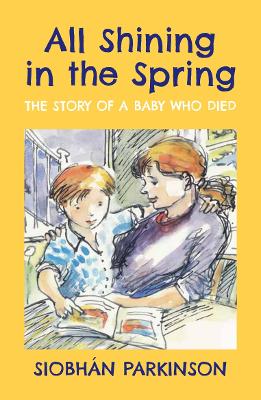
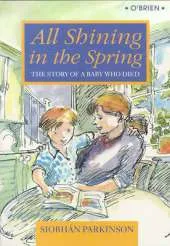
A book to help children and families cope with the loss of a baby.
Children's Book Council: Spring 2024 Showcase: Reading List: Transformation
Matthew is excited about the new baby. But then, one day, something very sad happens. The doctor tells Matthew's mother that her baby isn't growing properly and it won't be strong enough to live outside her body.
Matthew and his mother and father will always remember their baby. But as time goes by, they will not feel sad so often.
The author wrote this story based on her own experience, to help her son cope with the loss of a baby. This child-centred book is intended to help children and families who experience miscarriage, stillbirth, perinatal death or Sudden Infant Death Syndrome (SIDS).
A new edition of the first published book by Siobhán Parkinson, who later became Ireland's first Laureate na nÓg (Children's Laureate). It was writing this book that Parkinson found her voice as a children's writer, a gift she credits to the baby she lost all those years ago.
See More Personal & social issues: death & bereavement
See More Personal & social issues: family issues
See More Personal & social issues: sex education & the facts of life
No one has written a review for 'All Shining in the Spring: The Story of a Baby who Died'
Why not be the first to share your opinion?
Having grown up in Galway and Donegal, Siobhan Parkinson has lived most of her adult life in her native Dublin. She studied English literature and German at Trinity, and went on to take her doctorate in English literature. She has worked for many years as an editor, a profession that very closely resembles that of writing. She concentrates more on her writin
More about Siobhan ParkinsonBorn in Dublin in 1956 and brought up in Goatstown, Marita went to school at the Convent of the Sacred Heart, Mount Anville, later working in the family business, the bank, and a travel agency. She has four children with her husband James, and they live in the Stillorgan area of Dublin.
Marita was always fascinated by the Famine period in Irish history and