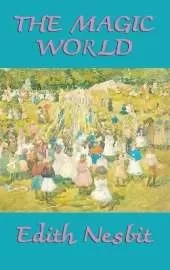
The Magic World (1909) is a collection of twelve children’s fantasy stories by English writer Edith Nesbit. Using elements of magic and mystery familiar to readers of her beloved Bastable and Psammead Trilogies, Nesbit crafts tales of wonder and adventure for children and adults alike.
In “The Cat-hood of Maurice,” a young boy learns firsthand the consequences of mistreating the family cat. One day, Maurice attaches an empty sardine can to Lord Hugh’s tail, terrifying and traumatizing the poor cat. When his father gets home, Maurice is told that he will be spending the next week at Dr. Strongitharm’s school for wayward boys. At the last moment, Maurice discovers Lord Hugh in his room, who reveals to the boy a magic word that will turn him into a cat. In “Accidental Magic,” a boy named Quentin is sent to school in Salisbury. Immensely interested in archaeology and history, Quentin is excited to learn that he will be able to visit Stonehenge while at school. After getting in a fight with a bully, Quentin runs away in fear of expulsion and escapes through the fields toward Stonehenge. There, he searches for the fabled altar stone, where, exhausted and scared, he falls asleep. When he wakes up, he finds he has been transported to the lost world of Atlantis, where the people call him the “Chosen of the Gods,” but fail to reveal what it is he is chosen for.
With a beautifully designed cover and professionally typeset manuscript, this edition of Edith Nesbit’s The Magic World is a classic of English children’s literature reimagined for modern readers.
This is Book 51 in the Mint Editions Series. See all Mint Editions books here.
No one has written a review for 'The Magic World'
Why not be the first to share your opinion?
E. Nesbit was a prolific English author, editor, and poet. Throughout her career, she penned or contributed to more than sixty works of fiction, poetry, picture books, and compilations of literature, although her primary success came from her children's books. She died in 1924, possibly due to lung cancer.
Arthur Rackham is often
More about Edith Nesbit
 The second book in a fabulous new magical, middle-grade series filled with adventure, wonder and wildness,