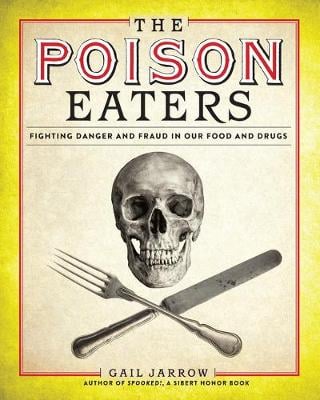
Formaldehyde, borax, salicylic acid. Today, these chemicals are used in embalming fluids, cleaning supplies, and acne medications. But in 1900, they were routinely added to food that Americans ate from cans and jars.
In 1900, products often weren't safe because unregulated, unethical companies added these and other chemicals to trick consumers into buying spoiled food or harmful medicines. Chemist Harvey Washington Wiley recognized these dangers and began a relentless thirty-year campaign to ensure that consumers could purchase safe food and drugs, eventually leading to the creation of the U.S. Food and Drug Administration, or FDA, a US governmental organization that now has a key role in addressing the COVID-19/Coronavirus pandemic gripping the world today. Acclaimed nonfiction and Sibert Honor winning author Gail Jarrow uncovers this intriguing history in her trademark style that makes the past enthrallingly relevant for today's young readers.
Six starred reviews -- Booklist BCCB Kirkus Reviews Publishers Weekly School Library Connection Shelf Awareness
An ALSC Notable Children's Book * A Washington Post Best Children's Book * NCTE Orbis Pictus Honor Book * A BCCB Blue Ribbon * A Kirkus Reviews Best Children's Book * A NSTA Outstanding Science Trade Book for Students K-12 * A Chicago Public Library Best Children's Book
"Revolting and riveting in turns, Jarrow's masterfully crafted narrative will fundamentally alter how readers view their food.Though laced with toxins, this is anything but toxic." -- Kirkus Reviews, starred review
No one has written a review for 'The Poison Eaters: Fighting Danger and Fraud in our Food and Drugs'
Why not be the first to share your opinion?
Gail Jarrow is the author of many popular nonfiction books, including Red Madness, Fatal Fever , and Bubonic Panic . Her books have received numerous starred reviews, awards, and distinctions, including Best Book awards from the New York Public Library, School Library Journal , the Bulletin of the Center for Children's Book
More about Gail Jarrow