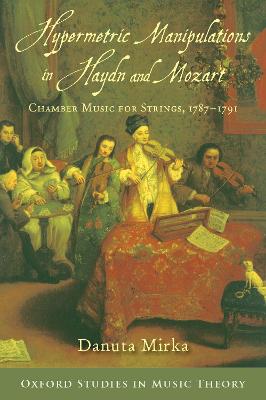
For the past four decades, the concept of hypermeter has been routinely applied to eighteenth-century music. But was this concept familiar in the eighteenth century? If so, how is it reflected in writings of eighteenth-century music theorists? And how does it relate to their discussion of phrase structure? In this book, a follow-up to the award-winning Metric Manipulations in Haydn and Mozart, author Danuta Mirka unearthes a number of cues that point to
eighteenth-century recognition of what today is called hypermeter, and retraces the line of tradition that led from eighteenth-century music theory to the emergence of the modern concept of hypermeter in the twentieth century.
Mirka describes the proto-theory of hypermeter developed by German music theorists, recounts the recent history of this concept in American music theory, evaluates contributions made to it by authors working within different theoretical traditions, and introduces a dynamic model of hypermeter which allows the analyst to trace the effect of hypermetric manipulations in real time. This model is applied in analyses of Haydn's and Mozart's chamber music for strings, which shed a new light upon this
celebrated repertoire, but the aim of this book goes far beyond an analytical survey of specific compositions. Rather, it is to offer a systematic classification of hypermetrical irregularities in relation to phrase structure and to give a comprehensive account of the ways in which phrase structure
and hypermeter were described by eighteenth-century music theorists, conceived by eighteenth-century composers, and perceived by eighteenth-century listeners.
This is Book 1 in the OXFORD STUDIES IN MUSIC THEORY Series. See all OXFORD STUDIES IN MUSIC THEORY books here.
See More Educational: Music
No one has written a review for 'Hypermetric Manipulations in Haydn and Mozart: Chamber Music for Strings, 1787 - 1791'
Why not be the first to share your opinion?