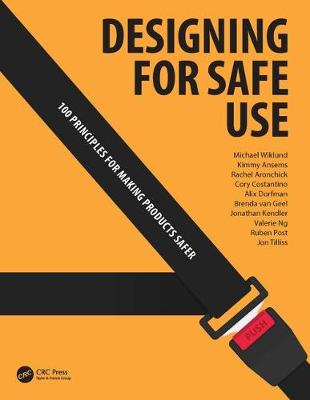
How do you prevent a critical care nurse from accidentally delivering a morphine overdose to an ill patient? Or ensure that people don't insert their arm into a hydraulic mulcher? And what about enabling trapped airline passengers to escape safely in an emergency?
Product designers and engineers face myriad such questions every day. Failure to answer them correctly can result in product designs that lead to injury or even death due to use error. Historically, designers and engineers have searched for answers by sifting through complicated safety standards or obscure industry guidance documents.
Designing for Safe Use is the first comprehensive source of safety-focused design principles for product developers working in any industry.
Inside you'll find 100 principles that help ensure safe interactions with products as varied as baby strollers, stepladders, chainsaws, automobiles, apps, medication packaging, and even airliners. You'll discover how protective features such as blade guards, roll bars, confirmation screens, antimicrobial coatings, and functional groupings can protect against a wide range of dangerous hazards, including sharp edges that can lacerate, top-heavy items that can roll over and crush, fumes that can poison, and small parts that can pose a choking hazard.
Special book features include:
No one has written a review for 'Designing for Safe Use: 100 Principles for Making Products Safer'
Why not be the first to share your opinion?
Michael Wiklund serves as general manager of the human factors engineering (HFE) practice at UL (Underwriters Laboratories). Previously, he founded Wiklund Research & Design, a human factors consulting firm that UL acquired in 2012. He has 30+ years of experience in human factors engineering, much of which has focused on medical technology development; optim
More about Michael Wiklund