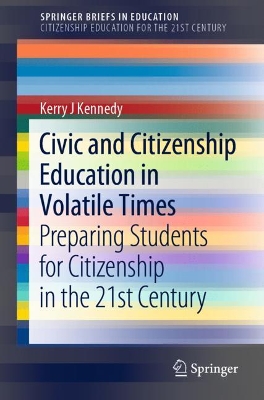
The book highlights current issues influencing civic and citizenship education and their theoretical underpinnings. It provides an overview of the key features influencing ‘democratic deconsolidation’ , suggests ways in which civic and citizenship education needs to be reframed in order to fit this new political environment, and demonstrates how social media will play a significant role in any future for civic and citizenship education. Currently, democratic institutions are under attack, democratic values are threatened, and there is a wide-scale retreat from the liberal consensus that has underpinned liberal democracies internationally. These trends can be seen in events like, Brexit, the election of a right-wing populist President of the United States and, anti-democratic governments in parts of Europe. It is this change in the direction of political ideology that is currently ‘deconsolidating democracy’ and thus challenging traditional approaches to civic and citizenship education. What is urgently needed is an understanding of these current trends and their implications for thinking in new ways about civic and citizenship education in the 21st century.
This is Book 13 in the SpringerBriefs in Education Series. See all SpringerBriefs in Education books here.
No one has written a review for 'Civic and Citizenship Education in Volatile Times: Preparing Students for Citizenship in the 21st Century'
Why not be the first to share your opinion?
Professor Kerry Kennedy is currently Professor Emeritus, Advisor (Academic Development) and a Senior Research Fellow at the Centre for Governance and Citizenship, Education University of Hong Kong. He is also a Distinguished Visiting Professor at the Faculty of Education, University of Johannesburg. His research interests are in curriculum policy and theory
More about Kerry J Kennedy