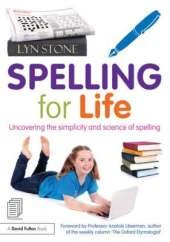
A recent survey of 200 teachers asking the question 'spelling is...?' resulted in the following adjectives: 'difficult', 'complex', 'confusing', 'random', 'confounding'. Spelling for Life offers lucid, accessible tools which help to reveal that, when explicitly and systematically taught, spelling is scientific, law-abiding and even elegant.
It explains that spelling is the manipulation of symbols according to agreed-upon patterns that produce predictable results. Spelling errors also fall into sets of predictable patterns. Success in spelling is not a product of intelligence. Many people struggle to spell due to coping strategies developed in place of explicit instruction. What gives spelling its 'complex' veneer is the fact that different ways of thinking are required at different levels from word to word. Some words can be spelt as they sound, others have to be visually memorised and some rely on knowledge of core rules about word-structure. A lot of words require more than one strand of knowledge. This book makes clear which strand needs to be applied in different situations.
Often pupils who can read and express themselves competently nevertheless find spelling difficult. False assumptions about spelling, such as believing the English language is complex and/or irregular, damage confidence and lead to reluctance to even attempt to spell correctly.
Spelling For Life enables teachers and pupils to:
No one has written a review for 'Spelling for Life: Uncovering the simplicity and science of spelling'
Why not be the first to share your opinion?
Lyn Stone is a linguist and literacy and language specialist in Victoria, Australia
Lyn's website www.linguistlearning.com provides resources for teachers and other professionals interested in linguistics in the classroom.