Do your students suppose that if the perimeter of a shape increases, the area also increases? Do they think that area is the product of base and height, without understanding that this applies only to parallelograms? Do they believe that a transformation happens only on or to a particular object and not the entire plane?
What tasks can you offer—what questions can you ask—to determine what they know or don’t know—and move them forward in their thinking?
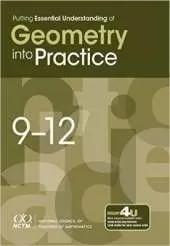
This book focuses on the specialized pedagogical content knowledge that you need to teach geometry effectively in grades 6–8. The authors demonstrate how to use this multifaceted knowledge to address the big ideas and essential understandings that students must develop for success with geometry—not only in their current work, but also in higher-level mathematics and a myriad of real-world contexts.
Explore rich, research-based strategies and tasks that show how students are reasoning about and making sense of geometry. Use the opportunities that these and similar tasks provide to build on their understanding while identifying and correcting misunderstandings that may be keeping them from taking the next steps in learning.
This is Book 2 in the Putting Essential Understanding Into Practice Series. See all Putting Essential Understanding Into Practice books here.
See More Educational: Mathematics & numeracy
No one has written a review for 'Putting Essential Understanding of Geometry Into Practice in Grades 6–8'
Why not be the first to share your opinion?
Karen Karp , University of Louisville.
Amy Roth McDuffie , Washington State University.

 The second book in a fabulous new magical, middle-grade series filled with adventure, wonder and wildness,