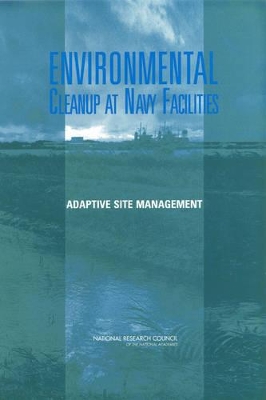
The number of hazardous waste sites across the United States has grown to approximately 217,000, with billions of cubic yards of soil, sediment, and groundwater plumes requiring remediation. Sites contaminated with recalcitrant contaminants or with complex hydrogeological features have proved to be a significant challenge to cleanup on every levela "technologically, financially, legally, and sociopolitically. Like many federal agencies, the Navy is a responsible party with a large liability in hazardous waste sites. Environmental Cleanup at Navy Facilitites applies the concepts of adaptive management to complex, high-risk hazardous waste sites that are typical of the military, EPA, and other responsible parties. The report suggests ways to make forward progress at sites with recalcitrant contamination that have stalled prior to meeting cleanup goals. This encompasses more rigorous data collection and analysis, consideration of alternative treatment technologies, and comprehensive long-term stewardship.
See More Educational: Biology
No one has written a review for 'Environmental Cleanup at Navy Facilities: Adaptive Site Management'
Why not be the first to share your opinion?
Mathematical Sciences Education Board, National Research Council
More about National Research CouncilWater Science and Technology Board, National Research Council
More about Water Science and Technology BoardCommittee on Environmental Remediation at Naval Facilities, National Research Council
More about Committee on Environmental Remediation at Naval Facilities
 The second book in a fabulous new magical, middle-grade series filled with adventure, wonder and wildness,