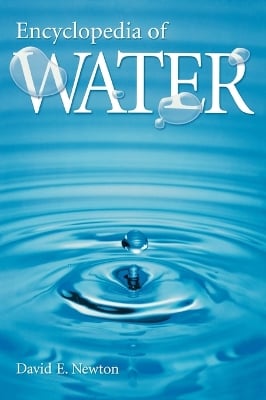
Water breaks rocks, levels mountains, and cuts canyons. It comes in many forms, from puddles, to icicles, to mist, to tidal waves. It covers most of the Earth and constitutes a majority of the human body. Too much water can destroy entire regions-so can too little. Life depends on it. We drink it, bathe in it, swim in it, drown in it, fish in it, heat up and cool off in it. One of the most versatile and familiar elements in the world, water is also one of the most mysterious.The 236 entries in this book comprise an A-Z overview of water's manifold roles in human society and the natural world throughout history. Topics include boats and ships, dams, groundwater, hydrology, ice, the Johnstown Flood, Scripps Institute of Oceanography, sea monsters, surface tension, and water wheels, and much more. Scientific and technical issues are explored, including the physical and chemical properties of water, steam, and ice; the uses to which water and steam are put; and the purification, transfer, and uses of water by communities. The hydrologic cycle is explained, with attention to the properties and distribution of ice masses, and the properties of oceans and rivers. Philosophical, mystical, metaphorical, and symbolic roles of water in literature, mythology, religion, the visual arts, and music are considered, as are individuals and organizations responsible for contributing to our understanding of water. This book includes a bibliography and a guide to related topics. Each entry concludes with a list of further readings.
See More Reference works
No one has written a review for 'Encyclopedia of Water'
Why not be the first to share your opinion?
David E. Newton holds an associate's degree in science from Grand Rapids Junior College, a B.A. in chemistry and an M.A. in education from the University of Michigan, and a Ph.D. in science education from Harvard University. He taught mathematics and physical sciences, was a professor of chemistry and physics at Salem State College, and was an adjunct profes
More about David E. Newton