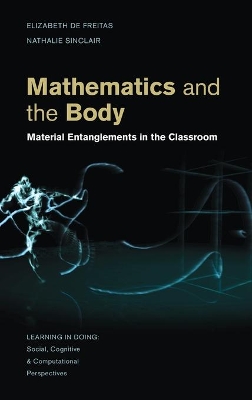
This book explores alternative ways to consider the relationship between mathematics and the material world. Drawing on the philosophy of Gilles Châtelet and the post-humanist materialism of Karen Barad, the authors present an 'inclusive materialist' approach to studying mathematics education. This approach offers a fresh perspective on human and nonhuman bodies, challenging current assumptions about the role of the senses, language, and ability in teaching and learning mathematics. Each chapter provides empirical examples from the classroom that demonstrate how inclusive materialism can be applied to a wide range of concerns in the field. The authors analyze recent studies on students' gestures, expressions, and drawings in order to establish a link between mathematical activity and mathematical concepts. Mathematics and the Body expands the landscape of research in mathematics education and will be an essential resource for teachers, students, and researchers alike.
This is Book 2 in the Learning in Doing: Social, Cognitive and Computational Perspectives Series. See all Learning in Doing: Social, Cognitive and Computational Perspectives books here.
See More Educational: Mathematics & numeracy
No one has written a review for 'Mathematics and the Body: Material Entanglements in the Classroom'
Why not be the first to share your opinion?
Elizabeth de Freitas is an associate professor at the Ruth S. Ammon School of Education at Adelphi University. She is the co-editor of Opening the Research Text: Critical Insights and In(ter)ventions into Mathematics Education (2008) and an associate editor of the journal Educational Studies in Mathematics. Nathalie Sinclair is an associate professor in the
More about Elizabeth de Freitas
 The second book in a fabulous new magical, middle-grade series filled with adventure, wonder and wildness,