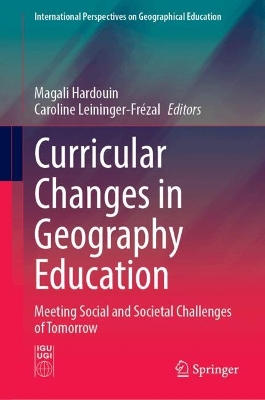
This book highlights the way in which geography curricula are conceived, (re)-organised and implemented at different levels (local, regional, national, international) and how to respond concretely to these challenges. It also examines the obstacles, barriers and continuities that keep some parts of geography curricula in a century-old tradition.
In this book, the term curriculum is used in its Anglo-Saxon conception, which differs from its European use, which is limited to study plans. The term curriculum used in this book, refers to the prescribed curriculum, sometimes called formal, and also to the taught or real curriculum as well as the learned curriculum. To these three curricular forms, a fourth is added, called the hidden curriculum. This includes what is implicit for the actors (teachers, pupils, the school institution) and what is, voluntarily or not, ignored or concealed.
The contributions to this book examine each type of these four curricula and their interactions. It discusses how the passage from one curriculum level to another is not linear and implies recompositions, ruptures as well as continuities. The book also touches on the circulation between the different curricular levels and how that raises the question of the articulation between policy(ies) and practice.
This is Book 2 in the International Perspectives on Geographical Education Series. See all International Perspectives on Geographical Education books here.
See More Educational: Geography
No one has written a review for 'Curricular Changes in Geography Education: Meeting Social and Societal Challenges of Tomorrow'
Why not be the first to share your opinion?