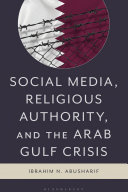
This book examines how the Arab Gulf Crisis (2017–2021) launched a robust social media reaction that seemingly – and perhaps perpetually – pushed the utility of religious maxims in social media spaces in a globalized manner and the ways in which religious authority has changed in the digital age.
Ibrahim N. Abusharif investigates how religious authority was mobilized through digital media, particularly through social media texts that used Islamic language to justify or contest the political blockade of Qatar by neighboring states. While the crisis unfolded with traditional geopolitical measures—severing diplomatic ties, imposing blockades, and disrupting trade—the digital battlefield became a parallel front where state actors, religious scholars, and influencers competed for narrative control.
Drawing on media texts by Gulf-based religious figures, the book reveals how scriptural allusions, moral framing, and juridical language were deployed to endorse or critique the crisis. The study challenges prevailing binary frameworks and proposes an interdisciplinary methodology combining media studies and Islamic studies to understand these complex digital discourses. It also positions the crisis as a key moment in the transformation of public religious expression in the Gulf, where the authority of traditional scholars contended with a networked public sphere.
Ultimately, this work offers a deep examination of how religion, media, and politics intersect in the digital age, and how future crises will continue to unfold across both physical and digital terrains.
No one has written a review for 'Social Media, Religious Authority, and the Arab Gulf Crisis'
Why not be the first to share your opinion?

 The second book in a fabulous new magical, middle-grade series filled with adventure, wonder and wildness,