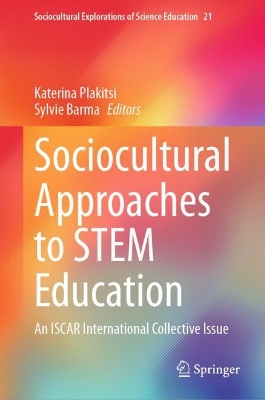
This book is a contribution to the sociocultural approaches to Science Technology Engineering and Mathematics (STEM) Education. It offers a new interpreting theoretical framework coming from the Cultural Historical Psychology. The authors highlight some serious elements of the sociocultural context that mediates learning on STEM or with STEM adds. The book brings together the work of researchers interested in developmental psychology and childhood, with a special focus on using Activity theory and Cultural-historical research approach to unite these two opposing approaches to the study of children. The authors reconsider our relationship and experiencing with technology. It moves the attention from the pure instrumental aspect of technology to a deep human and societal approach. Moreover, the book focuses on the issue of teachers' continuing education in both formal and informal settings is being seen under a sequential system of expansive cycles and the key role of contradictions in transformative educational settings. Overall, this book encourages the academic society to open dialogue with other societies and enhance interdisciplinary research in times of crisis.
This is Book 21 in the Sociocultural Explorations of Science Education Series. See all Sociocultural Explorations of Science Education books here.
No one has written a review for 'Sociocultural Approaches to STEM Education: An ISCAR International Collective Issue'
Why not be the first to share your opinion?

 The second book in a fabulous new magical, middle-grade series filled with adventure, wonder and wildness,